

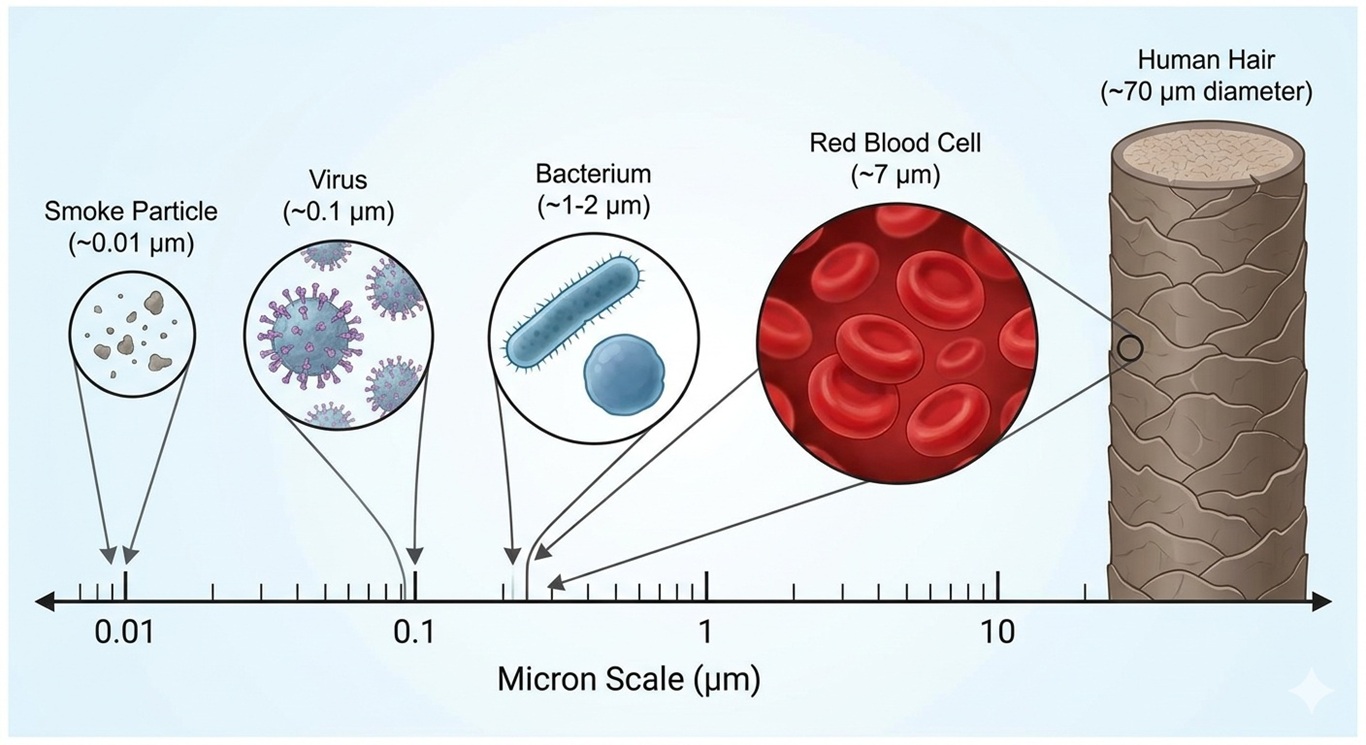
In the world of compressed air, “clean air” is a relative term. To a technician, the difference between a 1-micron and a 0.01-micron rating isn’t just a technicality—it is the difference between a high-performing system and one plagued by downstream contamination, pressure drops, and frequent, costly repairs.
At National Filters Pty Ltd, we often observe many operations either over-filtering their air, which wastes energy, or under-filtering, which damages equipment. Therefore, to find the right balance, you first need to understand the distinct roles of particulate and coalescing filtration.
1. Particulate Filters: The First Line of Defence
Particulate filters capture dry, solid contaminants like dust, scale, and metal filings. Typically, technicians install these filters upstream of the dryer or at the point of use.
Micron Ratings: Usually range from 1 to 5 microns.
The Goal: To protect the dryers internal components or pneumatic tools from mechanical wear.
Maintenance Tip: A 1 micron filter is often sufficient for general industrial air. However, if you are running sensitive CNC machinery, a 0.01 micron filter is essential to prevent “stiction” in valves.
2. Coalescing Filters: Removing the “Invisible” Killers
Screw compressors use oil for lubrication and cooling. Although the internal separator catches most of this oil, microscopic aerosols and oil vapors still escape. Coalescing filters merge these tiny liquid droplets into larger ones, allowing them to be drained away.
Micron Ratings: Range from 0.1 micron down to 0.01 micron.
The Goal: Removing liquid water and oil aerosols.
The Critical Factor: Coalescing filters are rated by efficiency (e.g., 99.99%) and oil carryover (measured in mg/m³).
Choosing the Right Rating for Your Application
The “correct” micron rating is dictated by what happens to the air after it leaves the compressor. For general workshop air, which includes air tools and inflation, a 1-micron particulate filter followed by a 0.1-micron coalescing filter is usually ample. This setup keeps tools lubricated without clogging them with sludge.
In contrast, professional spray painting and sandblasting require a high-efficiency coalescing filter. A 0.1-micron filter is the industry standard here. It is advisable to follow the 0.01-micron filter with an activated carbon filter to ensure no oil craters or “fish-eyes” appear in the paint finish.
Lastly, in the food, pharmaceutical, and electronics industries, these high-stakes environments often require a “polishing” stage. This involves a 0.01-micron high-efficiency coalescing filter followed by an activated carbon tower to remove oil vapours and odours.
| Feature | Particulate Filter | Coalescing Filter |
| Primary Function | Solid particle removal | Liquid/Aerosol removal |
| Micron Rating | 1µm – 5µm (Standard) | 0.01µm – 0.1µm (Fine) |
| Target Contaminants | Dust, pipe scale, rust, metal shavings | Oil mist, water aerosols, hydrocarbon vapors |
| Typical Position | Pre-filter (Protecting the dryer) | After-filter (Polishing air for equipment) |
| Pressure Drop Risk | Low (until clogged with solids) | High (if saturated with liquid) |
The Cost-Saving Reality: Pressure Drop
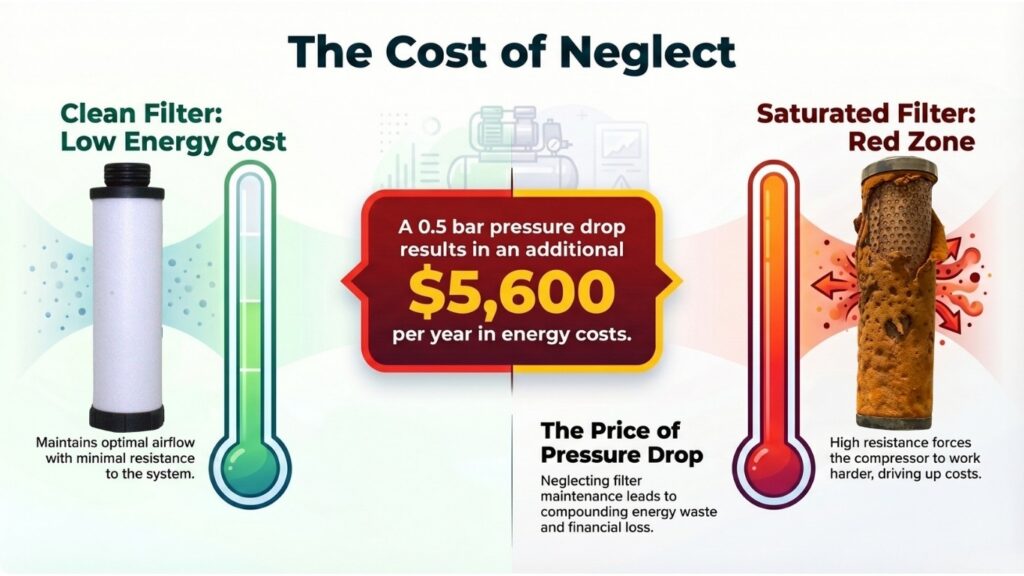
It is tempting to put the finest filter (0.01 micron) on every machine “just to be safe.” However, finer filters create higher resistance, known as pressure drop.
It’s important to remember that every 1 bar (approx. 14.5 psi) of pressure drop caused by a clogged or overly restrictive filter can increase your compressor’s energy consumption by roughly 7%. By selecting the exact micron rating required, and not opting for a sub-micron filter where a standard one will do, you can significantly lower your monthly power bill.
Summary Checklist
- Identify your “Cleanest” Point: What is the most sensitive tool on your line? Filter for that.
- Step Down: Use a coarse particulate filter (3 or 1 micron) to protect your expensive high-efficiency coalescing filters (0.01 micron). This prevents the fine filter from clogging prematurely with dirt.
- Monitor Delta P: Install differential pressure gauges. Replacing a filter element when it reaches a specific pressure drop (usually 0.35 to 0.5 bar) is cheaper than paying the energy costs of a struggling compressor.
Key Takeaways
- Clean air is vital for high-performing systems; understanding particle sizes is crucial for filtration effectiveness.
- Particulate filters remove solid contaminants with ratings from 1 to 5 microns, whereas coalescing filters target liquid aerosols with ratings down to 0.01 microns.
- For general workshop air, a 1-micron particulate filter followed by a 0.1-micron coalescing filter is typically sufficient.
- Using the right micron rating improves system efficiency and reduces energy costs; avoid unnecessary fine filters that increase pressure drop.
- Consider your most sensitive equipment when selecting filters and monitor pressure differences to optimise maintenance and performance.
Are you seeing oil in your lines or experiencing a sudden drop in pressure?
Tell us your compressor model or industry application, and we can recommend the specific filter grades to optimise your air quality and energy spend.
The Hidden Drain: Calculating the True ROI of Pressure Drop in Industrial Compressed Air Systems

Critical Medical Breathing Air Filtration for Hospital and Dental Systems

Achieving ISO 8573-1 Class 0 Oil-Free Air with Inline Filtration
Achieving Compliance: Compressed Air Standards for Australian Food & Pharmaceutical Manufacturing
ISO 8573-1:2010: The Definitive Guide to Compressed Air Quality Classes