


In the modern industrial landscape, compressed air is often referred to as the “fourth utility.” However, unlike electricity or water, the quality of your air is entirely dependent on your in-house treatment system. Consequently, without a clear standard, “clean air” is subjective. This is precisely why ISO 8573-1:2010 is the critical benchmark recommended for National Filters Pty Ltd clients.
Air compressors draw in airborne contaminants from the ambient air. Compressing the ambient air to 7 bar can increase the concentration of contaminants—dust, moisture, and oil—by up to 8 times. This guide breaks down the international purity classes to help you protect your downstream equipment and maintain regulatory compliance.
Understanding the Three Pillars of Air Contamination
The ISO 8573-1:2010 standard categorises contaminants into three primary groups. To achieve a specific purity rating, your inline filtration system must address all three:
- Solid Particulates: Dirt, dust, microbes, rust and pipe scale that cause abrasive wear in pneumatic tools and block sensitive orifices.
- Water (Moisture): Water vapour and liquid condensate that lead to pipe corrosion, frozen lines, and microbial growth in food-grade environments.
- Oil: Both liquid oil and oil vapour. Even “oil-free” compressors can suck in hydrocarbons from the ambient environment, necessitating high-efficiency coalescing and activated carbon filters.
Decoding the ISO 8573-1:2010 [A:B:C] Classification
Air quality is expressed as a three-digit code (e.g., ISO 8573-1:2010 [1:2:1]). Each digit represents a Purity Class:
- A: Purity class for Solid Particles
- B: Purity class for Humidity and Liquid Water
- C: Purity class for Total Oil
The Purity Classes Table
| Class | Particles (per m³ @ 0.1–0.5µm) | Water (Pressure Dew Point) | Total Oil (mg/m³) |
| 0 | As specified by user (stricter than Class 1) | As specified by user (Less than Class 1) | As specified by user (Less than Class 1) |
| 1 | ≤ 20,000 | ≤ -70°C | ≤ 0.01 |
| 2 | ≤ 400,000 | ≤ -40°C | ≤ 0.1 |
| 3 | – | ≤ -20°C | ≤ 1.0 |
| 4 | – | ≤ +3°C | ≤ 5.0 |
Industry Applications: Which Class Do You Need?
Selecting the wrong class can lead to either catastrophic product spoilage or unnecessary energy expenditure. Here are some examples of industry applications and the required classes.
- Food & Beverage (Class 1:2:1 or 1:3:1): Requires high-level moisture removal and oil-free filtration to prevent bacteria growth and “off-flavours” in packaging.
- Pharmaceuticals (Class 1:2:1): Absolute sterility is required. Use of sterile filters is mandatory.
- General Manufacturing (Class 2:4:2): Standard for protecting heavy-duty pneumatic cylinders and air tools from premature wear.
- Precision Electronics (Class 1:2:1): Prevents microscopic dust particles from ruining circuit board printing.
How to Achieve and Maintain Compliance
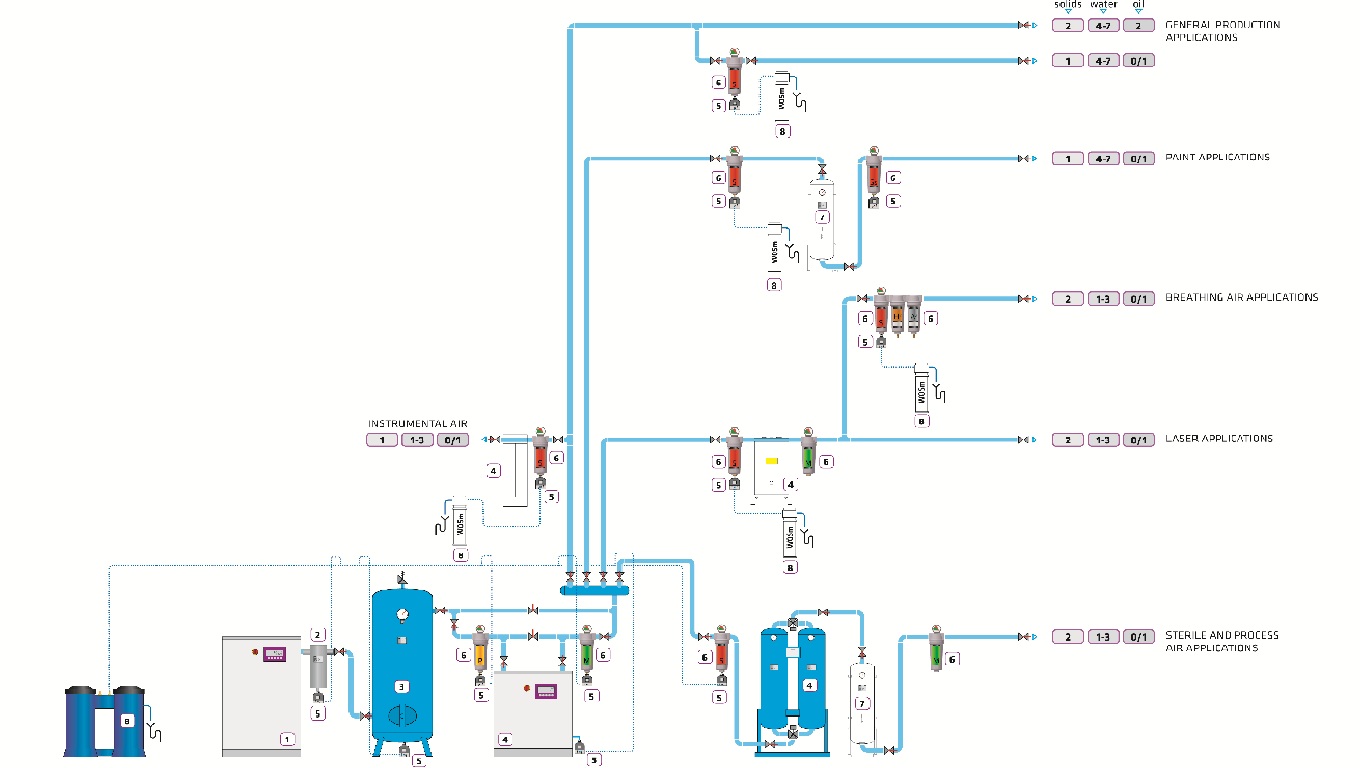
Achieving these standards requires a coordinated “treatment train.”
- Filtration Selection: Use a combination of bulk liquid separators, general-purpose filters, high-efficiency coalescing elements and activated carbon elements.
- Element Maintenance: Filter elements are consumable. As they saturate, pressure drop increases, costing you more in electricity. National Filters recommends replacement every 12 months or 2,000 hours, or if pressure drop is noticed to ensure you stay within your ISO class.
- Oil-Water Separation: To meet Australian environmental standards, ensure your condensate is treated via a WOS Oil-Water Separator before disposal into sewerage systems.
Expert Support for Your Facility
Not sure if your current system meets ISO Class standards? National Filters Pty Ltd provides the technical expertise and replacement elements required to keep your Australian and New Zealand operations running efficiently.
Contact our technical team today for a comprehensive air quality consultation.